


DarkLordOfOptics
Politics • Science & Tech • Sports
Guns, Optics, 2nd Amendment and resisting the Left in everything they touch.
Interested? Want to learn more about the community?

Learn more first
Weekend musings and updates

A little while back, I made a conscious decision to shift the bulk ofo political coverage to my substack page. There are a few reasons for that, but the primary one is to keep this one largely oriented toward guns and optics. The idea was to restrict political coverage here to 2A issues.
It is never a clear distinction, but I try.
Another was that the political world is all consuming and I wanted to relegate it to weekends only. Unless there is something truly momentous happening, I try to ignore the world of politics during weekdays and catch up during the weekends. That's why my substack coverage of the Iran war, for example, is restricted to mostly weekly attempts to make sense of the nonsense.
https://darklordofoptics.substack.com/
Of course, I always have a secondary purpose. Having learned my lesson on bans, shadowbans, and outright censorship over the years, if Substack goes totalitarian on me, I can shift what I normally do there to Locals and vice versa. A little paranoia goes a long way.
Going back to the gun related things, some of my long running plans are hitting a little bit of a snag this spring. It looks like I will need to have a minor abdominal surgery sooner than later and I have no idea what the recovery will look like. If all goes well, I will have a rough idea of the timing during this coming week.
That puts my plan to shoot the match in Wyoming in potential jeopardy, but hopefully not.
I was told that the recovery takes about six weeks and that I should avoid strenuous activity while recuperating. I plan to classify shooting an NRL Hunter match as non-strenuous activity and see where that takes me. As long as I am able to hike around a little, I can just shoot everything standing off of a tripod to minimize the probability of stitches coming out.
For the Hunter match in Wyoming, my original plan was to shoot with the same 6.5CM Fix wearing a 7-35x56 Tangent Theta and Hornady's factory 147gr ammo.
For the Hunter match in Virginia in May, I was hoping to test Grayboe's new Core stock, which fits my 6.5PRC Stag Pursuit. However, there is a delay in the manufacturing of the stock, so it won't get here until June.
Perhaps, that will be the one to take to the TRT Sniper match in Montana, although I am going to think about that a little more. If the barrel in my Fix is still alive by then, I might still just stick with it. It might be getting to tis last legs though by summer.
Grayboe has this new generation of stocks they are doing built around their mini-chassis that attracted my attention.
https://www.grayboe.com/products/universal-mini-chassis
While I am very much on the record that I think monoblock receivers are a better idea, the vast majority of the industry for legacy, logistical and logical reasons, runs on conventional barreled actions. I am always looking to see if someone has a better way to accommodate those and Grayboe's idea looks interesting. Essentially, they made a mini-chassis that bolts onto your action and stays there. Then they machine their stocks to match that minichassis perfectly. If you want to switch stocks between different Grayboe models, the mini-chassis stays bolted to the action and you swap the stock seamlessly and allegedly with no zero shifts.
For example, if I want to use my Stag Pursuit in 6.5PRC for a match or two, I can put it into a very solid forged carbon fiber Core stock.
https://www.grayboe.com/products/the-core
If I were to take the same rifle hunting, I can pop it out of the Core stock and put into the much lighter Halo stock.
https://www.grayboe.com/products/grayboe-halo-rifle-stock
Going from forged carbon fiber Core stock to forged fiberglass Halo stock immediately drops the weight by 3 lbs without changing anything else. Switching from a heavy match oriented bipod to light weight hunting ones gives me another two pounds (toughly). In other words, I can shed around five pounds of weight from this rifle by switching stocks and bipods without having to touch the optic.
The other interesting aspect of this approach is that you can use the same stock with different action types. For example, if I get their minichassis for the Pursuit action (R700 pattern) and another for my Tikka T3x, I can seamlessly switch stocks between these two very different actions.
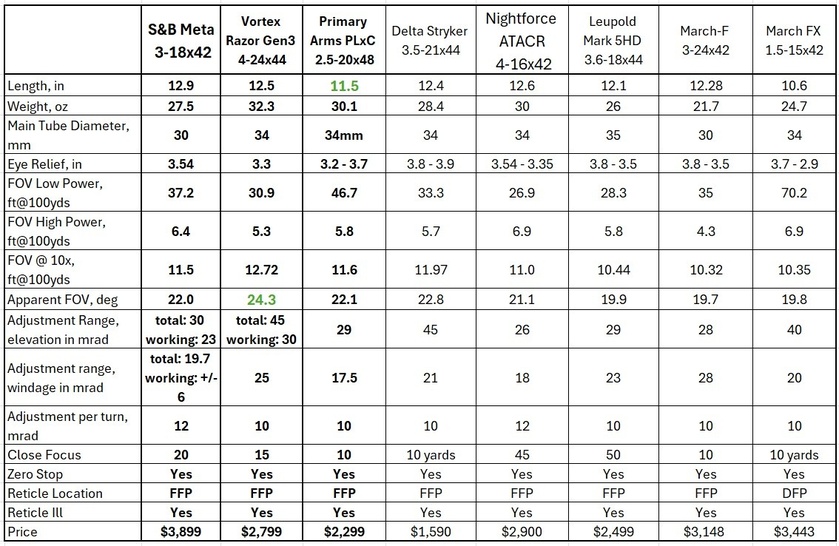
The plan is to use S&B's excellent 3-18x42 FFP Meta on this gun as a crossover: https://eurooptic.sjv.io/DWVxo2
Looking at the timelines, I'll be doing these experiments in the summer.

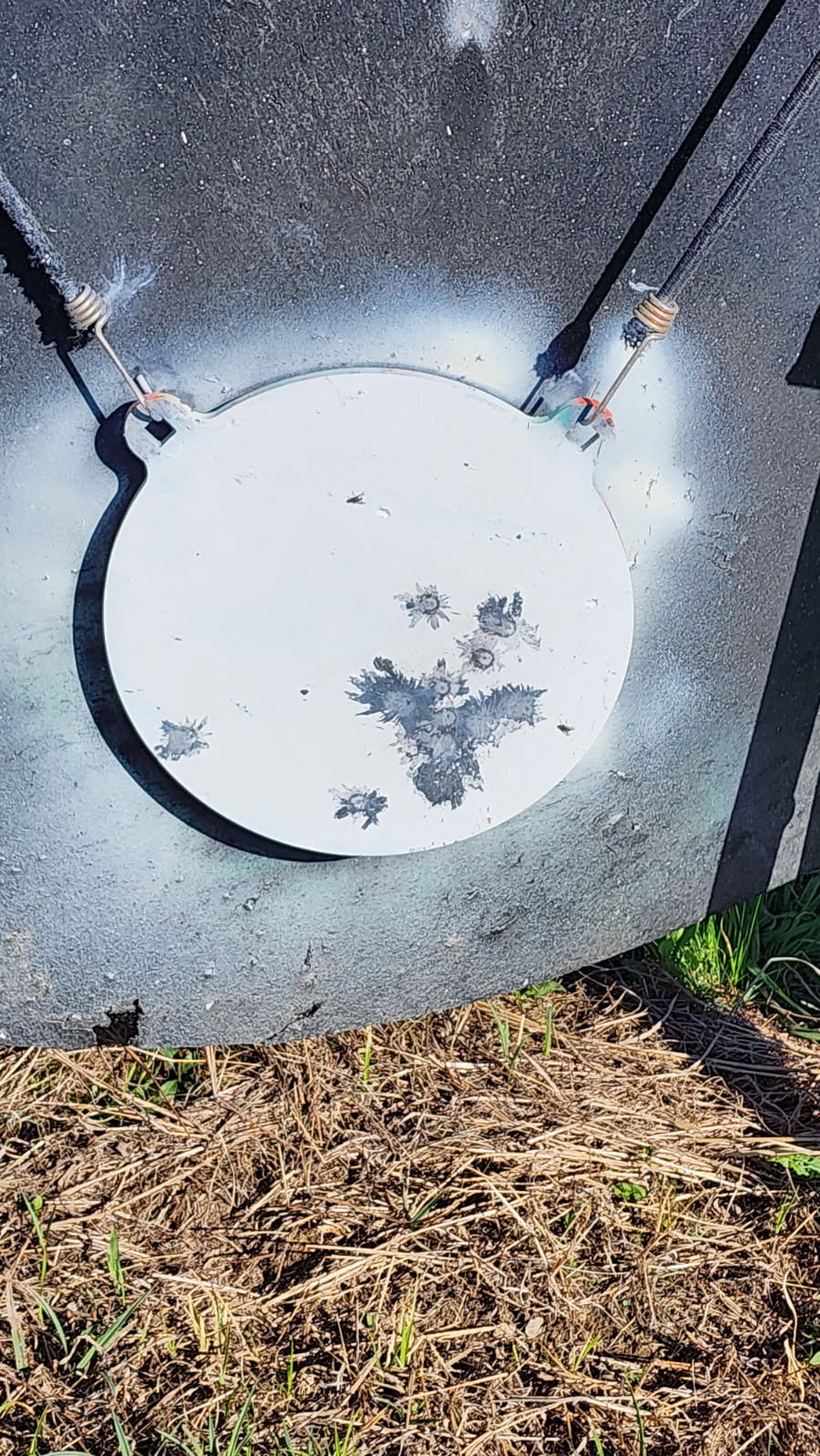
Another rifle experiment is the structured barrel that I have been talking about a good bit recently. That will likely show up here at around the same time and will initially see use in local matches. When I visited Tacom, in order to see where the heat in that barrel goes, I rapidfired a 10round mag of 6.5CM at a plate around 360 yards away. The picture of the plate is attached. I pressed the trigger as rapidly as I could. The POA never moved off the plate, so it was pretty rapid. The barrel was still barely more than lukewarm and not uncomfortable to touch. Accuracy also seems to be there. The barrel that is going into my 6.5CM upper is currently in cryo. This is going to be really interesting. Structured barrels are expensive. For a fully machined and chambered barrel it seems to be in the ballpark of $2k. However, the barrel life they are seeing is substantially longer than that for conventional high end barrels. hat changes the value proposition. I'll continue digging into it. Given how vibrationally dead it is and how it manages heat, this might be THE right solution for an accurate semi-auto. With boltguns, it is probably a tougher sell for relatively conventional boltguns and calibers, but for larger overbore cartridges that generate a lot of heat, like 300NM, etc it might be a different story.
I am going to start with a large frame AR and go from there. The way they do structured barrels is a seemingly outlandish idea, but now that I have spent some time with them, I am quite enamored with the concept. They do all the machining in house, which is probably a big reason for the cost. On the other hand, they do it very well. I wonder if there is a viable way to scale up and bring the price down, but that's a conversation for another day.

Another experiment I am looking to do at some point is with Outlier's Backdraft system. For background, the guys who were behind Arken started Outlier on the side. Now that the optics part was restructured, they are out of the optics business and in the barrell/chassis/suppressor business.

They are using the volume of a sleeved barrel as a huge expansion chamber for initial sound suppression and for temperature control. The basic principle is very simple. Because the gasses exiting the muzzle do so very rapidly, it is essentially an adiabatic process. If you give it a lot of volume, pressure and temperature have to come down very fast. That potentially allows for tiny suppressors that do not get very hot. The chamber area of the barrel and all that still gets pretty hot. In most ways it is not particularly different from other sleeved barrels aside from using the space between the barrel and the sleeve as an expansion chamber. I've reached out to them. We'll see how it goes.

As an aside, since I assume there is no love lost between the new DNT/Arken and Outlier, now that they are separate companies, I am very curious if they will look to partner with any optics company for their guns. While, I've had a complicated relationship with Arken over the years, I do think that the Backdraft concept in Outlier barrels is very interesting and plan to test it one way or the other.

Switching back to optics, what little shooting I have been able to do lately has been primarily aimed at the MPVO segment, since I want to finish my review of the Element Theos 2-10x42. https://alnk.to/dWfYoIF

My original impressions have not changed: it is an exceptional scope with the only real weaknesses being the weight and the somewhat bulky windage turret that gets a little bit in the way of the offset dot. I have been messing with mounting options and I think now I have it set up just the way I want it. It is an exceptional scope overall.

On the other side of the MPVO range is the Primary Arms 1.5-12x36 that has been the subject of quite a few heated discussions (largely between people who have not seen it, but who am I to judge). https://alnk.to/cSLqvYh

In terms of mag range, size and weight, this is the purest expression of the MPVO idea yet. The downside is that it is intended to be used at distance with reticle holdovers only. I think that is an oversight, but since they designed the scope for easy configuration changes down the line, I hope they will have product line extensions. As is, the scope is light, handy and excellent optically and mechanically. The reticle is pretty easy to use and I got the hang of it, but at distance it is not fast at longer distance. Basically, it is not a reticle for precision guys who want to set up a light weight platform to shoot accurately fairly far away.

Theos 2-10x42 is much better configured for the crowd stepping down from their precision competition rigs to go play.

Primary Arms PLxC 1.5-12x36 is set up for AR guys who have been shooting their LPVOs and finding their limitations at distance. They are now looking to extend the range beyond what they do with LPVOs, but not adapt to what long range guys usually do. They are looking for that same "LPVO" experience, but better on mid/high magnifications. They will love this scope and it is set up for them.

I have a little bit of equity with both of those crowds and I have become rather fond of both Theos and PLxC, but they do have different appeal.

If I want to stretch my AR's legs out to 800 yards, I will go with Theos.

If the distances will stay more moderate and might involve clip-ons and such, I will lean toward the PLxC, especially if I have to carry this thing.

I am going to try to convince Primary Arms to extend the line-up a little bit. I would really like to see a version of this 1.5-12x36 scope with a single turn exposed zero stop turret and a simpler tree reticle so that the scope can be used with reticle holdover at closer distances and with dialing for a bit further out.

Basically, if I could get PLxC 1.5-12x36 with Theos-ish reticle and H6Xi-style elevation turret, I think that would be a perfect MPVO for my purposes.

That wraps it up for today. I'll keep you posted as all these projects move forward.

post photo preview
Interested? Want to learn more about the community?

Learn more first
What else you may like…
Videos
Posts
Articles
Keltec CP33 Project: Phase 3

Here is another range day update.

It seems that I have all of a sudden started reviving some old projects. This latest one is the CP33 from Keltec.

I got one a few years ago when I bailed out of California. After all the PRK restrictions, the allure of a 33 round magazine was nearly insurmountable.
Well, as I learned, not all Keltec products work straight out of the box, but they do have good customer service.

Eventually, I got it to the point where it functioned reliably when reasonably clean. Interestingly, the problem is usually with getting the first round into the chamber. After that, there are seldom any issues.
Over time, I added a brace adapter from Rehn arms and hinged pistol brace from Q. CP33 has an mlok slot on the dustcover, so I added an extra magazine holder on there (from Otterman Outdoors).
The barrel is fixed and threaded, so I equipped it with Q's El Camino suppressor.
The full length picatinny rail on top has Shield SIS sitting on it.
The whole thing ended up ...

00:04:08
Range Day: Subsonic ELR

Here is my sinister plan for what I can do at the range while still technically recuperating.

I revived my subsonic ELR project:
Q Fix handgun with 8" barrel https://alnk.to/gVP8WV9
Subsonic 8.6BLK https://alnk.to/9xnjKFM
March 1.5-15x42 https://eurooptic.sjv.io/VOaNGA
Area 419 rings https://www.anarchyoutdoors.com/area-419-scope-rings-hunt/?ref=fl0iza41
Porq Chop suppressor https://alnk.to/faFz8Pp

The whole thing is under 10lbs.
There is no recoil.
It is "Hollywood" quiet.
It is VERY challenging.

Because of the light weight of the gun and the rather long dwell time of the bullet int he barrel, this gun is incredibly difficult to shoot well at distance.
It is, however, very entertaining and very good practice.

I was trying to figure what I can do that is precision oriented without having to rebuild my rather portly precision rimfire.

That's when I remembered about by somewhat dormant subsonic ELR project and got it set it up just before surgery.

It weighs nothing, so I will ...

00:01:48
Area 419 Hellfire Ti Brake

I was looking over my past reviews and realized that I havn't really done a video on the Hellfire Ti brake from Area 419.

In the grand scheme of things, I am not big on brakes. However, you do not always get what you want and I do have two firearms equipped with brakes.

One is an Encore muzzleloader that launches a 275gr bullet at 2400fps out of a 9lbs gun. It is unpleasant without a brake.

Another is the Stag Pursuit in 6.5PRC that you see in the attached video. I put it together as my "restricted state" gun and I chose a brake where I though I would get the best muzzle flip control at the lowest weight rather than the most muzzle control at more weight than half of my suppressors.

https://www.anarchyoutdoors.com/area-419-hellfire-ti-self-timing-brake/?ref=fl0iza41
Hellfire Ti is still loud, but not as obnoxious as dedicated competition brakes. It does control muzzle rise exceedingly well despite compact size and sub 3 ounce weight.

00:08:24
May 15, 2026

How's your postop recovery going? Hope you're doing OK with minimal discomfort.

Primary Arms PLxC 1.5-12x36 is finally in stock

Both reticle versions are in stock on Primary Arms' website:

https://alnk.to/cb6EzxA

I am quite impressed with this scope and if you are looking for an MPVO and the reticle works for you, I can comfortably recommend it.

It is light, handy and stupid fast on 1.5x.

It is intended to be utilized with capped turrets using the reticle for holdover.

I have mine on a 8.6Blackout Boombox and it is perfect there.

post photo preview
Heading home

As is often the case, if you do not see me post anything for a few days, chances are that I am off somewhere.

In this case, I had to go to DC for a tradeshow (on my 50th f-ing birthday, of all things) and since I was there, I stuck around for the weekend to shoot in the Spears Mountain Safari NRL Hunter match.

The match was a blast, but I shot like shit. In terms of marksmanship, this is probably the worst I have shot in quite a long time.

I am quite certain that the gear was fine and the problem was primarily between my ears, but naturally I am still going to try to solve superclavicular problems with gear.

Since I was flying to DC, I did not want to experiment with bringing a suppressor here. I decided to take my Stag Pursuit boltgun chambered for 6.5PRC that is set up with a brake. I have S&B's new FFP Meta 3-18x42 mounted on it and running a match with it was a good exclamation point for my review of it (spoiler alert: it is an exceptionally nice scope).
Rather than bring the large Zeiss tripod with me, I used a somewhat ...

post photo preview
post photo preview
Visiting with TacomHQ

This week was my kids' spring break, so we ended up going on a road trip of sorts.  We flew to Houston, rented a car, visited the Space Center, checked out Galveston, then drove up to Dallas.  My dayjob is in Dallas and I need to visit the office occasionally.  Truthfully, I need to visit the office more often than I currently do, but given my family situation that is a little tricky.

My kids are very good travel companions, so we decided to drive back to Albuquerque instead of flying.  The way the timing worked out, we had a day to make a detour and drive up to Arkansas to visit John Baker and his Tacom HQ operation.

I've known John for a few years.  He has visited with me about three years ago to talk about his their reticle idea and a few other things  

I think the reticle idea is sound and we should see a version of it in a scope soon enough.  I'll do a thorough coverage at that point.

This time around, the reticle was not the main reason behind my visit.  John is a creative guy and they do several interesting things there.  Everything they do is clever and outside the box.  For example, to the best of my knowledge, they were the first to come up with different ways to shift the POI for ELR shooting with their TARAC devices.  Alpha and Bravo TARAC devices use prisms to shift the zero of the optic, but a predetermined angle.  I have a flip-up Alpha TARAC set up to help with my subsonic ELR pursuits.  Bravo TARAC attaches the prism to the objective of the riflescope which works beter with large objective designs.  Since Tacom came up with it, the idea has been pirated by a couple of people, most prominently by Nightforce.  Technically, Tacom has a patent on it, but this appears to be a situation where a large company (Nightforce) shamelessly muscled a small company (TacomHQ) out of their IP, knowing fully well that they have more money for lawyers.  To be fair, John does not talk about it too much, so this is just a guess on my part (although I am sure I am going to get a nastygram from Nightforce lawyers for posting this.  They seem to really enjoy pushing small independent guys around).

Charlie Tarac uses a periscope instead of a prism to optically add slope for ELR shooting.  Delta Tarac does mostly the same things except it also offsets the line of sight laterally to avoid the mirage from the barrel.

The new thing with TARAC devices for this year seems to be an adjustable version of the Charlie.  There is a large side wheel that allows you to dial up to 900MOA of extra slope.

The reason I wanted to spend a little time with Tacom was the structured barrel.  I first ran into this concept a few years ago and thought it was an interesting idea.

Initially, my plan was to pick an appropriate action and have John make me a 300NM structured barrel for an ELR bolt action rifle.  I still want a 300NM and I might put one together eventually.  However, I never quite pulled the trigger on that for a few reasons.  One is that I simply have very limited use for such a gun.  I still want one, but I do not have easy access to a place wehre I can really stretch the legs of a caliber with that kind of capability.  The reason I wanted to put one together with a structured barrel is that they are are getting very good lifetime out of these and they are very easy to get to shoot properly.  

They have several version of the structured barrel design, but fundamentally they start with a 1.5" diameter barrel blank and mill out a bunch of material.  The most disinctive features are deep longitudinal cylindrical channels drilled parallel to the bore.  The start at the muzzle and go back toward the chamber.  They do not make it all the way to the chamber.  On the outer surface of the barrel, there are additional featuers designed for eliminating vibrational nodes and increasing surface area for better heat exchange.  There is quite a lot of technical informaiton on their website: https://tacomhq.com/structured-barrels/

Structured barrels look very beefy because they start out from large diameter blanks and they are decidedly not light-weight barrels.  However, by the standards of typical match barrels they are on the lighter side of things because of how much material has been removed.  Given their impressive vibration dampening advantages, a few months ago I shifted gears and started leaning toward putting together a large frame AR around Tacom's structured barrel.

With the precisely calculated mechancial structure, these barrels acomplish two very complicated things simultaneously: they are harmonically dead and they do not get hot.

During my visit, we shot two guns with structured barrels: a 6.5CM AR-10 and a 300NM bolt gun.

We did not do mag dumps or anything that silly.  However, after 10 rounds of rather rapidly fired 6.5CM, the barrel was warm, but not hot.  Temperature distribution was arguably the most remarkable part.  Using an infrared thermometer, it was easy to show that the warmest part of the barrel was around the middle (near the gas block on the semi-auto),  The breech end of the barrel was cooler to the touch and measure at a lower temperature.  Basically, the barrel never got very hot and whatever heat it accumulated was shed very rapidly.

The feel of the recoil impulse is really odd in that it is completely muted and there was no muzzle rise to speal off.  I suspect a part of the was the muzzle brake, but this lack of discernible resonant frequencies made the recoil cycle extremely gentle.  I was shooting an IPSC at 350 yards and the recoil impulse never moved the reticle off the plate.  I fired the last four shots as rapidly as I could pull the trigger.  Everything was on the plate.  The rifle was not light at right around 14lbs with the scope, but I expected a lot more movement out of it even with the muzzlebrake.  Most gas guns have this slight "pitchiness" to them and I saw none of that.

The 300NM boltgun was slightly heavier, but with the much more powerful round the recoil did move the reticle off of the target, but not by much. 

I never lost sight of the target during the reocil impulse and the feel was, again, very muted and controllable.  I am not sure how heavy the boltgun was, but definitely less than 20lbs.  I would guess it was around 17lbs, but I'll check with John.

While both guns were very impressive, the semi-auto shot unlike any other gas gun I have ever pulled the trigger on.  No gas gun ever has a truly free floated barrel, since there is a gas block attached to it.  However, the combination of the structured barrel with a unque way that John has of putting the upper together, is the closest I have seen to date.

He bonds the barrel extension to the upper receiver and then screws a shouldered barrel into that.  The upper receiver is the Aero M5E1 Enhanced since the beefy upper receiver extension helps decouple the handguard from the barrel.  Also, the rather beefy structured barrel needs a large diameter handguard which this is.  The gas block they make is a custom affair that is probably better described as "tunable" rather than adjustable.  It is not designed for making frequent adjustments.  The idea is to tune your gas system for perfromance and reliability, then leave it alone.  I plan to do exactly that.

Since I was heading this way, I brought the necessary pieces with me for John to put together a 6.5CM upper for me.   Originally, I was thinking of doing it in 6XC for local PRS matches, but now that I shot with it, I want to try using it for NRL Hunter as well.  I think I can make weight without too much trouble.  I'll stick with 6.5CM in order to make power factor for Hunter matches.

Saying that I was impressed would be a gross understatement.  The feel of this gun is absolutely unique and it has recoil control behavior of a 25lbs gun in a 14lbs package.  It is quite remarkable.  Now, in the grand scheme of things, with my nearly 300lbs bulk backing up the gun, recoil control is a relatively straightforward affair.  Since my kids were there with me, I had both of them shoot both guns and watched the recoil cycle very carefully.  The guns barely moved even with a much smaller human behind them.

I know it sounds like magic, but it isn't.  I am not a mechanical engineer, but I spent a good amounf of time going over the materials and thinking through what they are doing with these barrels.  The science behind it is pretty solid.  I am not seeing any obvious holes in their foundational reasoning.  The execution is difficult and the barrels are not cheap.  Aside from good ideas, it takes a lot of skill and know-how to make these.  There is a good chance I will make a permanent switch to these barrels on what I consider my "heavy" precision guns while sticking with the Fix as lighter guns they way they were originally intended to be.  When I say heavy, I mean sub-20lbs with everything and light is sub-13lbs with everything (scope, suppressor, bipod).

Before I wrap up, let's get back to the heat management argument for a moment.  The 300NM I shot was significantly accurate and it is at a bit over 2800 rounds.  That sounds outlandish given that is nearly triple of I would expect out of this caliber.  However, if the chamber never gets very hot, it is possible.  I really want to know how long the 6.5CM John is building for me will last.  I have high hopes.


Read full Article
Here is an interesting question I got after the last livestream
I do read all comments

I got an interesting question via Youtube after the last livestream.  Here is it is verbatim:

"Ilya I hope you read the comments. I’ve got an optics question that I can’t seem to find an answer to. 
In reference to competition style scopes. Ones that seem geared towards PRS or other similar styles of shooting. Is there some good reason that the manufacturers constantly put out stuff with a low end mag that is basically unusable? Weight? Clarity? Something else?
I’m thinking of things like the K540i, Vortex 6-36, Tangent, Zco. I’ve never seen anyone shoot these scopes below 10x and most of their reticles are completely unreadable at low magnification. Why not start the low end at something like 10x or 12x and use a similar or lower zoom ratio? A 10-30 seems much more useful in PRS compared to a 5-25 since it’s my understanding that a lower zoom ratio is easier to make."

The biggest reason is simply marketing.  People who actually compete are a relatively small minority.  They do not really need low magnification.  Most people who spend money on scopes are looking at specs and a large magnification ratio is more marketable.  There are of course other practical reasons too.

When you design a riflescope, you are generally trying to hit multiple birds with one stone.

For example, if you want it to appeal to some potential military contracts, you need some sort of a viable low magnification to use with clip-ons.  Many of the clip-ons available to the military work pretty well on higher magnifications, but they generally want to have low pwoer in the 4x to 7x range.

As far as the reticle not being usable on low power, that is a consequence of making reticle very thin for use on high power.  This is also where military applications and civilian competition applications have different needs.  More military oriented reticles tend to be slightly thicker and I often prefer those.  

However, the simple truth is that reticle illumination pretty much solves that problem nicely since most low power use is in low or fading light.

The extended range features of a reticle (christmas tree, etc) seldom come into play in low light, so if the reticle simply has something like an illuminated cross, it works very well.

For what it is worth, even in daylight, I shoot my Tangents below 10x all the time, though not much belwo 10x.  In NRL Hunter matches, for example, since I am pretty new at this and have a hard time finding the plate, I figured out during my very first match that keeping my 7-35x Tangent on 9x, really helps me get behind the rifle quickly and get it stable quickly.  As I got a little better at getting into a proper shooting position efficiently, I bumped it up to about 12x.  When practicing, I routinely keep magnification low when shooting off of props.  When I am not pressed for time and shoot a bit further out, I'll bump up the magnification a little to have a better look at the mirage.  However, I virtually never shoot above 20x unless I am screwing around with some very small targets at close ranges (like the 1/4" hanger on the KYL rack) which is mostly done with rimfires and airguns.

Moving on.... a few years ago when I was chatting with a guy who designs riflescopes for a living, I asked him that the ideal magnification ratio is, where you have a good enough magnification range without any really significant optical compromises.  He said that it is right around 5x, i.e. 5-25x, 7-35x, etc.  When riflescope optical systems are designed, they are not all ground up designs.  For example, you can take a well worked out erector system and use it in a range of scopes.  LPVOs are a little different, but you can use more or less the same erector and eyepiece for several different designs: 2-12x, 3-18x, 4-24x, 5-30x can have very significant part commonality.  Noone is itching to design a standalone 3x erector just for the highest magnification scope because it just adds extra cost and might not offer any advantages beyond potentially slightly lighter scope and somewhat easier assembly/alignment.  

The idea of a competition dedicated high power riflescope that is 10-30x or something along those lines comes up every few years as does the concept of a dedicated 14x fully optimized for matches.  Every time, it fails the basic test of economics: how much will it cost to develop vs how many you might sell.

Read full Article
post photo preview
Zenith Rifle by Alpine Riflecraft
First Look at The Ultimate Mountain Rifle

As many of you are likely aware, I am heading out to Montana for a mule deer hunt in a few days.  I will also have an additional cow elk tag, since I did not draw anythign in New Mexico.

My original plan was to borrow one of the MegaFix prototypes from Q.  However, all three properly fucntioning prototypes of the MEgaFix they have are in Africa taking down a broad range of animals.  The way I go hunting usually involves two rifles.  One primary, which is typcially something I am doing an article on and one backup which is something I know works in case I need it in a pinch.

My backup rifle is the OG Fix chambered for 308Win.  You have seen this gun many times over the years.  It was the subject of a dedicated video.  

I hunt with it and occasionally shoot NRL Hunter matches with it (shot two this year).  

As configured, it clocks in at a bit under 11lbs with the scope, https://alnk.to/af179CG, bipod, full length Arca rail from Sawtooth and LSP vertical grip.  I could make it a little lighter, but after some consideration, I decided to keep it in this configuration.  Eventually, I will upgrade it to Area 419 rings (I have been slowly switching to them almost across the board), but beyond that I plan to do absolutely nothing with it until I finally shoot the barrel out.  Ammo is a different ballgame and I am about to embark on an experiment with NAS3 cases, but that's a story for another day.

I still wanted somethign new to test, so I reched out to my Guns & Ammo editor to see if he has any ideas.  He usually does and this case was not the exception.  He connected me with a gentleman who owns a Canadian company called Alpine Riflecraft.  They are on a mission to make the world's best mountain hunting rifle and the Zenith is the product of their efforts.

I have now spent a couple of days at the range with it and have some early impressions to share.

Only for Supporters
To read the rest of this article and access other paid content, you must be a supporter
Read full Article
Available on mobile and TV devices
google store google store app store app store
google store google store app tv store app tv store amazon store amazon store roku store roku store
Powered by Locals