DarkLordOfOptics
Politics • Science & Tech • Sports
Scope Mounts: Griffin SPRM
January 03, 2024

Continuing with the overview of the mounts I have on hand...

To date, I have talked abotu a good number of different single piece mounts.  I really liked Reptilia AUS and Area 419 mounts.  Badger Unimount is probably my choice if you want to be under $200.  Someone told me they are discontinued, but there are still a few out there (OpticsPlanet, Inc - 4355).  Seekins MXM and its Vortex equivalent have been very solid in my practice.  There are a couple of simple inexpensive mounts out there from Brownells and SwampFox that work surprisingly well, but I have to admit I have not tried them with precision scopes.  Going back to the higher end of things, I have a 34mm Era-tac Adjustable slope mount that will be a subejct of a future article.  I also have an M-Brace mount from ARC.  It is generally a good mount, but I naturally have a couple of reservations.  I will cover that in the future as well.  Another mount that I have not talked about a lot is Wanre Precision MSR.  I am reasonably happy with it though on balance, I think I like Reptilia a little more.

My original favourite was the Aadmount and in terms of the clamp design I think it is still the best (Seekins is somewhat similar conceptually, I think).  Unfortunately, they are not made any more.  I hope they will come back eventually.

If there are other mounts out there I should be looking at, please let me know.  Once I am done with these, I'll be ready to explore something else.

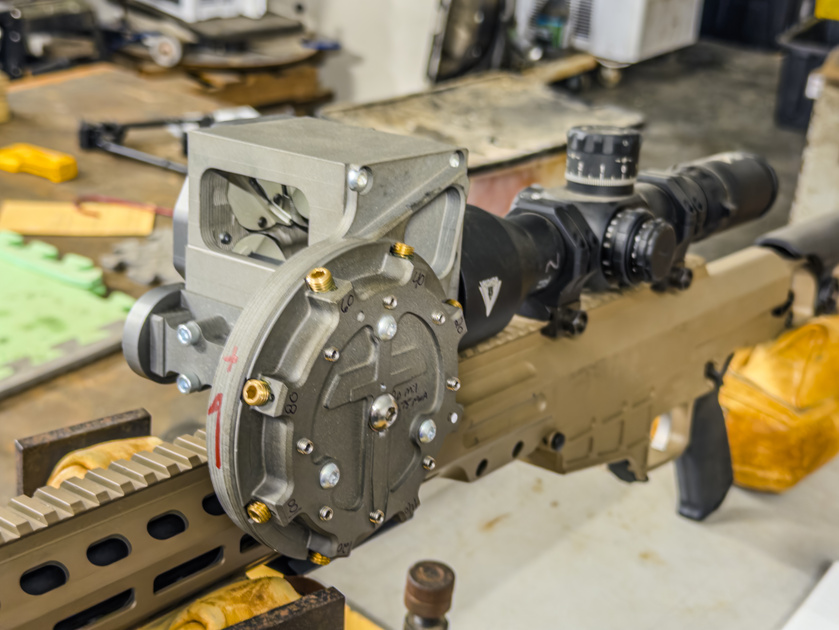
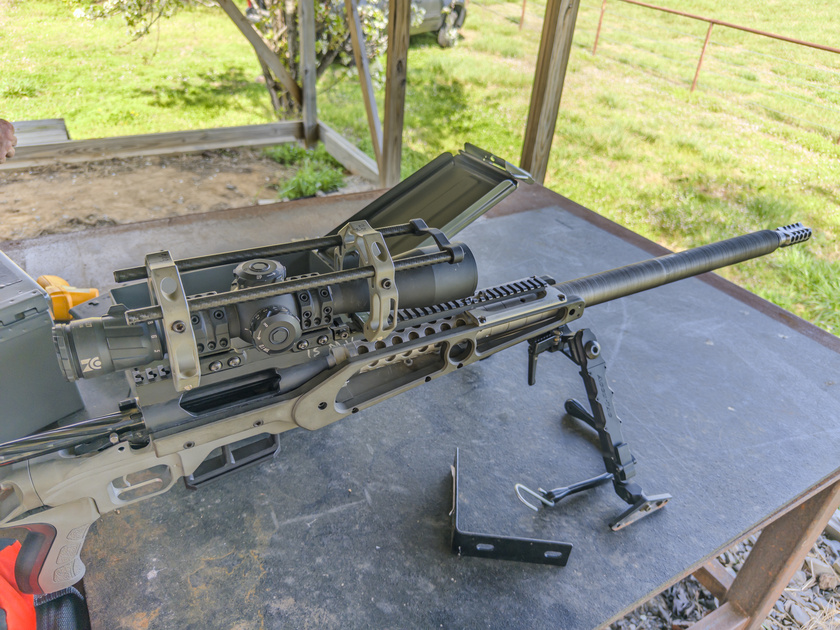
The subject of this article is Griffin's SPRM mount.   I am sure the name of the mount is not accidental.  The version I have is the one specifically intended for the S&B Ultra Short 5-20x50.  That scope does not have much of a maintube to work with and the original version had the illumination knob right in front of the eyepiece.  Normally, SPRM mount has six screws on both rings.  This version has six screws up front and four in the back because there was not enough space.  I no longer have the S&B I got the mount for, but the very short March 1.5-15x42 is back here, so I used the mildly pornographic SPRM mount with it.
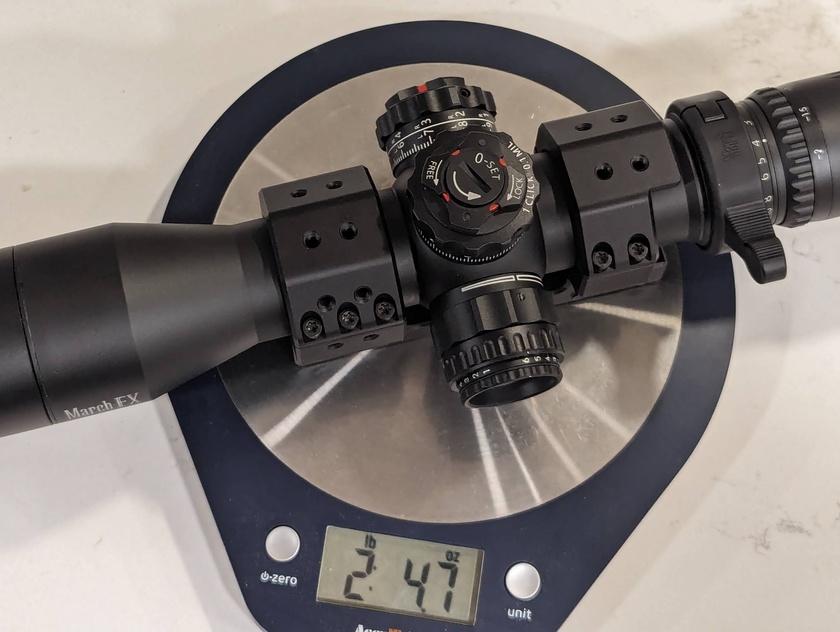
The plan is to put this scope onto my 8.6Blackout Fix.  It should be a good match there.  For all the subsonic shooting I do, it would be better to have a mount with slope, but it will do in the short term.  March has 40mrad of adjsutment and a tree reticle, so it will take my subsonic 8.6 loads a bit past 500 yards.  

Eventually, I'll replace it with something lighter.  For this application, I am not hugely concnerned with accessory mounting.

The SPRM mount is, by modern standards, comparatively inexpensive at $200 for the base mount https://bit.ly/4aF7jpr

It is machined out of 6061 aluminum.  All the different cross sections seem fairly stiff.  In terms of ring half stiffness, it is not bad.  The ring gaps on two sides are offset in order to allow additional accessory mounting points.  That means on one side the screws are pointing up and on the other, they are pointing down.  It is a little bit of a pain in the ass, since there is some interference with the screws on the clamp.
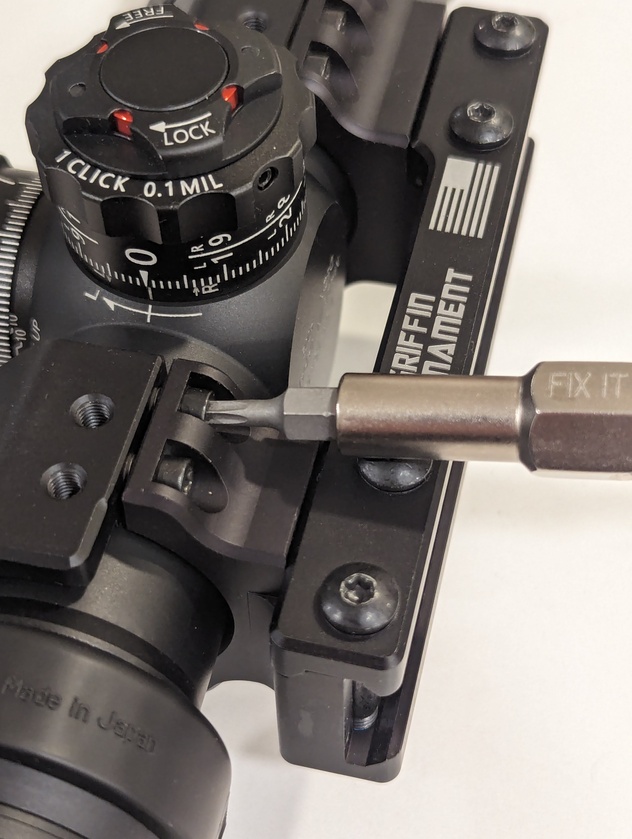
It is generally a somewhat awkward mount to set up.  The picatinny clamp is a long sinle piece, which I do not like.  There are four cross screws that also serve as recoil lugs.  The clamp screws are not recessed, which is also a somewhat odd decision.  You have to be a little careful with how you tighten the clamp or you will have a wondering zero.

The accessory mounting depends on the friction between the accessory rail and the mounting area.  Two 8-40 screws hold the accessory plates in place.  It is not a great way to go.  You want interface geometry to define all the positoning, not surface friction.  There are quite a few different availabel itnerface plates.  I have the offset picatinny and RMR plates.They work well enough until they shake themselves loose.  A little sleeve-type (green?) loctite would probably help keep them in place.  In other words, I do not think it is the cleverest mounting interface in the world, but that is resolvable.  Area 419 and M-Brace use much better approaches, but cost a lot more.
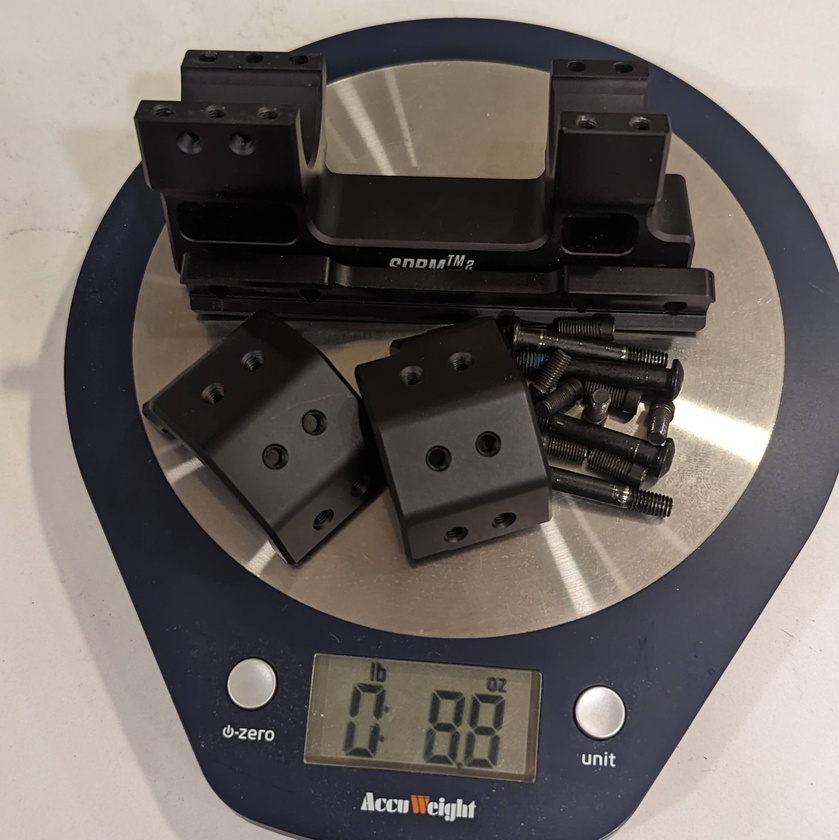
Despite being fairly solid, the mount is not terribly heavy.  Still, I can shave off three ounces if I switch to the Reptilia or something like that.

If you pay attention and tighten everythign carefully and evenly (and with a torque wrench), it seems to stay zeroed.  It does not return to zero all that great in my experience and I suspect it has something to do with the geometry of the clamping bar.  Still, once set up, it stays that way.  All fasteners are T15 which makes for reasonable convenience.

I am also not crazy about six screw rings.  Unless you are preparing for some truly massive recoil, it is not clear to me what the reason behind that is.  This is not unique to Griffin, of course.

All in all, it is a serviceable mount, but not my top choice.  The appeal is that you get a mount set up for accessory mounting for comparatively less money than a lot of the other brands out there.  The accessory mounting interface, however, is a little suspect.


community logo
Join the DarkLordOfOptics Community
To read more articles like this, sign up and join my community today
3
What else you may like…
Videos
Posts
Articles
WInchester 12x50 Binoculars

Here is something a bit different for you.
I do not spend enough time on the more budgety side of things, so I am trying to rectify that.

https://alnk.to/5jo73hd

00:10:00
Tripods

If memory serves me right, I have been promising a reasonably comprehensive video on tripods and tripod use for a little while now. Well, this is not it.

I did try to get together a bunch of different tripod types that I have on hand and discuss what I like about them and what I do not like about them. Most importantly, I tried to explain why my preferences are the way they are.

If this topic is of interest, I'll expand more on it.

As is, my plan for the time being is to use the Zeiss Max Duty with the V-60 head for precision. https://alnk.to/4MDNfR0

It is a decidedly pricey option, but it is a very clever design. If I were to look for similar functionality at a lower cost, Sunway's T4030 with IB-60 inverted ball head is half the price https://sunwayfoto.com/products/sunwayfoto-ht4030cmi-inverted-leg-carbon-fiber-69-tall-load-66lb-30kg?ref=DLO&variant=46025667805342

If you want to go a little lighter, you can got for a leveling base. Alternatively, you can outfit the T4030 Sunway ...

00:32:53
MPR-1D Reticle in Element Theos 2-10x42

Next week, I am on travel, but I did manage to finally sneak in a little range time this weekend. I shot a local PRS-style match with a semi-auto (that will eb a separate post), took a couple of new shooters for some basic training and generally tried to spend time outdoors.

One of the things I kept up with was the further evaluation of the Element Theos 2-10x42 MPVO riflescope https://alnk.to/2jPbb3d

At around $2500, it is a fairly pricey scope, but it does a couple of things that are not commonly available from most other MPVOs.

One of those things is the incorporation of diffractive reticle illumination.

That allows for a FFP reticle that is comfortably day bright, so that on low power when the reticle is fairly thin, you have a very pronounced aiming point within an open FOV. You can go pretty fast on 2x if you have a bright aiming point. Not as fast as on 1x, but quite fast. Still, I'd be inclined to use this scope on a DMR-ish AR with an offset RDS.

Now that I have a ...

00:04:15
Black Friday Deals, etc

This post is going to remain pinned at the top of the page for the next week or so.

There will be all sorts of Black Friday, pre-Black Friday, post-Black Friday, Cyber Monday, etc deals going around. Rather than spam your inbox with a new post every time I see something interesting, I am going to add new content to this post. It might be worth your while to glance at it occasionally.

Eurooptic is running a crazy deal on SAI6 scopes where they are going for $750 https://alnk.to/7McHLod
That's a very good price. My favourite version is the MRAD with RAF.
They also have VTXBF discount code on most Vortex scopes and a bunch other discounts https://alnk.to/dpuX9Ar
One of the more outstanding deals is the Vortex Razor Gen2E 1-6x24 with EBR-7F reticle. It is a reticle specific requested by some interesting units in the US military. It is a glass etched reticle with nuclear bright diffractive illumination. It is stupid fast on 1x and they are selling with a pretty nice mount to boot. https://alnk.to/58tmLjK
In general, they ...

Happy Thanksgiving, Y'al!

Somehow we live in a world where everything is in some way controversial.
To my considerable surprise, even Thanksgiving, somehow, is objectionable to a lot of people.
It is a festive day when we get together with friends and family, put our many differences aside, share companionship and eat ourselves into a food induced coma.

It should be as simple as that.

PragerU did a couple of good videos on the history of Thanksgiving that are short and to the point:

and

Happy Thanksgiving!

Another new arrival: Primary Arms SLx Compact 4-16x44 with Deka G2 reticle

Returning to the spirit of looking at optics that do not require you to sell a kidney, I looked around a little and asked the good people at Primary Arms to send me their compact 4-16x44 scope to play with.
Technically speaking, it was probably unfair for me to ask them for this scope. Looking at the configuration, it was immediately apparent that I was going to find something to complain about: it has covered turrets coupled with a mil-hash Deka G2 reticle.

However, that Deka G2 reticle, combined with very compact overall size is exactly why I wanted to look at this scope. This reticle is clearly aimed at precision people and it does not have a chevron. Precision guy have bitching about the chevron in PA's reticle for years. Personally, while I am not a huge fan of the chevron in precision scopes, I also do not mind it very much.

I first saw Deka G2 in the higher end PLxC scopes last SHOT, but those have been delayed, so this 4-16x is my first chance to play with this reticle.
...

Here is an interesting question I got after the last livestream
I do read all comments

I got an interesting question via Youtube after the last livestream.  Here is it is verbatim:

"Ilya I hope you read the comments. I’ve got an optics question that I can’t seem to find an answer to. 
In reference to competition style scopes. Ones that seem geared towards PRS or other similar styles of shooting. Is there some good reason that the manufacturers constantly put out stuff with a low end mag that is basically unusable? Weight? Clarity? Something else?
I’m thinking of things like the K540i, Vortex 6-36, Tangent, Zco. I’ve never seen anyone shoot these scopes below 10x and most of their reticles are completely unreadable at low magnification. Why not start the low end at something like 10x or 12x and use a similar or lower zoom ratio? A 10-30 seems much more useful in PRS compared to a 5-25 since it’s my understanding that a lower zoom ratio is easier to make."

The biggest reason is simply marketing.  People who actually compete are a relatively small minority.  They do not really need low magnification.  Most people who spend money on scopes are looking at specs and a large magnification ratio is more marketable.  There are of course other practical reasons too.

When you design a riflescope, you are generally trying to hit multiple birds with one stone.

For example, if you want it to appeal to some potential military contracts, you need some sort of a viable low magnification to use with clip-ons.  Many of the clip-ons available to the military work pretty well on higher magnifications, but they generally want to have low pwoer in the 4x to 7x range.

As far as the reticle not being usable on low power, that is a consequence of making reticle very thin for use on high power.  This is also where military applications and civilian competition applications have different needs.  More military oriented reticles tend to be slightly thicker and I often prefer those.  

However, the simple truth is that reticle illumination pretty much solves that problem nicely since most low power use is in low or fading light.

The extended range features of a reticle (christmas tree, etc) seldom come into play in low light, so if the reticle simply has something like an illuminated cross, it works very well.

For what it is worth, even in daylight, I shoot my Tangents below 10x all the time, though not much belwo 10x.  In NRL Hunter matches, for example, since I am pretty new at this and have a hard time finding the plate, I figured out during my very first match that keeping my 7-35x Tangent on 9x, really helps me get behind the rifle quickly and get it stable quickly.  As I got a little better at getting into a proper shooting position efficiently, I bumped it up to about 12x.  When practicing, I routinely keep magnification low when shooting off of props.  When I am not pressed for time and shoot a bit further out, I'll bump up the magnification a little to have a better look at the mirage.  However, I virtually never shoot above 20x unless I am screwing around with some very small targets at close ranges (like the 1/4" hanger on the KYL rack) which is mostly done with rimfires and airguns.

Moving on.... a few years ago when I was chatting with a guy who designs riflescopes for a living, I asked him that the ideal magnification ratio is, where you have a good enough magnification range without any really significant optical compromises.  He said that it is right around 5x, i.e. 5-25x, 7-35x, etc.  When riflescope optical systems are designed, they are not all ground up designs.  For example, you can take a well worked out erector system and use it in a range of scopes.  LPVOs are a little different, but you can use more or less the same erector and eyepiece for several different designs: 2-12x, 3-18x, 4-24x, 5-30x can have very significant part commonality.  Noone is itching to design a standalone 3x erector just for the highest magnification scope because it just adds extra cost and might not offer any advantages beyond potentially slightly lighter scope and somewhat easier assembly/alignment.  

The idea of a competition dedicated high power riflescope that is 10-30x or something along those lines comes up every few years as does the concept of a dedicated 14x fully optimized for matches.  Every time, it fails the basic test of economics: how much will it cost to develop vs how many you might sell.

Read full Article
post photo preview
Zenith Rifle by Alpine Riflecraft
First Look at The Ultimate Mountain Rifle

As many of you are likely aware, I am heading out to Montana for a mule deer hunt in a few days.  I will also have an additional cow elk tag, since I did not draw anythign in New Mexico.

My original plan was to borrow one of the MegaFix prototypes from Q.  However, all three properly fucntioning prototypes of the MEgaFix they have are in Africa taking down a broad range of animals.  The way I go hunting usually involves two rifles.  One primary, which is typcially something I am doing an article on and one backup which is something I know works in case I need it in a pinch.

My backup rifle is the OG Fix chambered for 308Win.  You have seen this gun many times over the years.  It was the subject of a dedicated video.  

I hunt with it and occasionally shoot NRL Hunter matches with it (shot two this year).  

As configured, it clocks in at a bit under 11lbs with the scope, https://alnk.to/af179CG, bipod, full length Arca rail from Sawtooth and LSP vertical grip.  I could make it a little lighter, but after some consideration, I decided to keep it in this configuration.  Eventually, I will upgrade it to Area 419 rings (I have been slowly switching to them almost across the board), but beyond that I plan to do absolutely nothing with it until I finally shoot the barrel out.  Ammo is a different ballgame and I am about to embark on an experiment with NAS3 cases, but that's a story for another day.

I still wanted somethign new to test, so I reched out to my Guns & Ammo editor to see if he has any ideas.  He usually does and this case was not the exception.  He connected me with a gentleman who owns a Canadian company called Alpine Riflecraft.  They are on a mission to make the world's best mountain hunting rifle and the Zenith is the product of their efforts.

I have now spent a couple of days at the range with it and have some early impressions to share.

Only for Supporters
To read the rest of this article and access other paid content, you must be a supporter
Read full Article
Reference Standard, 2025
Quite a few changes


As a reminder, the plan is to choose scopes as my reference standards in a few categories and make sure I keep them on hand for at least a year or so.  If they move on somewhere, I have to designate something else as the reference standard in that category.  There might be a couple of reference standard designs in each category to split them by price range.

Here is the riflescope categorization that I like to use https://darklordofoptics.locals.com/post/5212669/riflescope-type-classification 

Do keep in mind, that some categories I am not as well versed in as I'd like to be.  Also, there might be scopes in each category I consider exceptional, but do not have on hand.  Reference standard has to be something I have here and will use as a basis for comparisons.  I will endeavor to use optics that I believe to be at the top of their category, but it is not always possible.  Natirually, these will lean heavily toward mrad designs.  I avoid MOA like the plague whenever possible.


Fixed 1x
Interestingly, I do not actually have any 1x prismatics at the moment.  However, a friend of mine inherited the PA GLx 1x and my brother has Primary Arms SLx 1x Microprism.  https://bit.ly/3uLqu0E I Most of the differences between modern 1x prismatics come down to reticles and eyebox.  On balance, GLx is probably the yardstick for the rest of them.


Fixed mag small prism
No changes here.  This can go in a variety of different directions depending on personal preferences and price.  It is not practical to have a reference standard for every magnification and with compact prismatics I do like 3x as a good compromise magnification.  These scopes are a step up from people who have been using red dots with magnifiers and want a better experience at distance.  This one will also go to Primary Arms.  Technically, I like GLx 2x more than SLx 3x, but 2x is such a unique magnification that it is not a very good yard stick for comparisons.  SLX 3x Microprism it is, then.  


Fixed mag large prism

Somewhat oddly, with large prism scopes, I start leaning toward higher magnifications.  I want these in 4x or 5x.  I view these differently.  These are, to me, alternatives to LPVOs and spiritual successors of old general purpose 4x and 6x fixed power scopes, except more compact and with wider FOV.  There a couple of good options and, unsurprisingly, my favourites are Element Immersive 5x30  and the discontinued Elcan Spectre OS 4x.  The dual power Spectre DR is still thriving, as expensive as it is.    I have the single magnification 4x and it is a very good yardstick for what a high end prismatic should be.  With the Element, I am clearly biased since I designed the reticle for it.  In other words, I got to put a reticle I could not get other people to make into a scope I like.  You should not be terribly surprised to see it here.


LPVO

This one gets tough and there will be several options here.  Keep in mind that I like FFP LPVOs once we get up in price.  One of the reasons it gets tough is that as I keep putting together ARs for various family members, different LPVOs I have tend to migrate elsewhere.

With budget LPVOs, for now, I think Primary Arms SLx 1-6x24 with Nova reticle is the one to beat, but I no longer hae one here.  I should probably get another one and keep it here for comparison purposes.

On the mid-range, it is a battle between SAI6 1-6x24 with mrad reticle and the new PA PLxC 1-8x24 with day bright reticle illumination.  With PA, the reticle got a bit better sicne they went to diffractive illumination, but I would prefer a short mil tree of some sort.  It is light and short with an excellent eyepiece.  With SAI6, I like the whole reticle line-up but lean toward the mrad designs for general purpose use.  The X-Wing style high visbility feature is not for everyone, but it works for me.  I suppose I will keep both here.  

If you go up in price, my basic opinion has not changed.  Vortex Razor Gen3 1-10x24 is the one to beat if you want a nuclear bright reticle.  However, the notably less expensive PA PLxC with RDB reticle is absolutely giving it a run for its money.  The mrad reticle in the Vortex is more my cup of tea, though.

This leaves a little of a "no-man's land" with LPVOs that are designed to be true general purpose designs, like the side focus equipped March Shorty 1-10x24 and Delta Stryker 1-10x28.  They are a little too different to serve as a useful yardstick for anything but each other.  I ended up keeping the Delta.  Side focus really helps behind clip-ons.


Dangerous Game

I may have to skip one because I do not really have anything on hand right now (rifle-wise) that fits the description.  If I were to buy one, let's say a traditional 375H&H or 416Rigby, it would get Primary Arms' PLxC 1-8x24 SFP with fiber reticle.  In case it has not come through too well, I really like the PLxC line-up.


MPVO

For the time being, the one to rule them all is the dual focal plane March 1.5-15x42 https://bit.ly/4bjm15X  This category, almost by definition, is the one where compromises are made for the most flexibility.  This March is not perfect, but it is the best we currently have.  On the budget end, the yardstick should be Athlon's excellent Helos BTR Gen2 2-12x42, but it is sitting on top of a friend of mine's rifle two states to the West.  It can't be a reference standard if it is not here.  In the meantime, the old reliable SWFA SS 3-9x42 will do.  I have a couple of them.  https://swfa.com/swfa-3-9x42-ss-hd-mil-quad-reticle-30mm-tube-1-mil-clicks-ffp/

There is a big gap between a $600 SWFA and a $3100 March.  In the mid-range, Steiner H6Xi 2-12x42 with STR-Mil reticle is easily my favourite.  If I were going to have only one MPVO and I was payign for it out of my own pocket, Steiner would probably be it, so it is staying here.


Tweener

I do not like to use a discontinued scope as a yardstick, but Razor HD LH 1.5-8x32 has got to be it.  It is not a common scope category, so we will hoble along like this until I come up with something still manufactured (that fits the profile and I like).  On the low-ish end of the price range,  I do like SWFA 2.5-10x32 Ultralight and have a couple of them.  https://swfa.com/swfa-2-5-10x32-ss-ultralight-msr-556-bdc-reticle-1-tube-25-moa-clicks/ 

GPO makes a 1.5-9x32, but I do not have one.


Crossover

For once, this one is easy and I'll keep it all within a sane-ish price range.  Vortex Razor HD-LHT 4.5-22x50 and Delta Stryker 3.5-21x44 https://annexdefense.com/delta-stryker-hd-3-5-21x44-rifle-scope/ are the purest expressions of the crossover idea I have seen to date, this side of Tangent TT315M that you will see a couple of categories down.


Traditional Hunting

This get difficult again because it is not a type of a scope that is common around these parts and the ones I look at do not stick around too long.  I simply happen to be an FFP guy.  However, some hunting scope articles are very much overdue and I do have an excellent Delta Titanium 1.5-9x45.  In sticking with sane prices, let's add Tract Toric 2.5-15x44 with illuminated reticle to this list. 

These two should give me a decent ability to compare.  On the high end, there is the rather remarkable Tangent Theta Long Range Hunter that is the one to beat which is why it is not going anywhere.


General Purpose Practical Precision

Given how much this crosses over with, pun intended, crossover designs above, I could have merged them into signle category.  It would make too much sense so here we are.  Tangent Theta TT315M 3-15x50 is still it to me.  It does have limited elevation travel, so you have to be somewhat careful with how you mount it (in extreme cases, Burris XTR Signature rings where you can use their inserts to adjust slope may be needed).   Still, I have found nothing better yet.

If you want something more reasonably priced, I am going to go with the Telson Toxin 3-18x50 which repalces the very nice Burris XTR3i 3.3-18x50.  Both are very solid scopes, but Telson reticle has better visibility and it controls flare a little better.


Long Range Practical Precision

I might catch a lot of flack for this one, but so be it.  

High end: There are several spectacularly capable options, but there is a reason I shoot with the different Tangent Thetas, 5-25x56 and 7-35x56

Best bang for the buck on the high end: Vortex Razor Gen3 6-36x56 https://alnk.to/74xn2BV

Mid-range: Delta Stryker 4.5-30x56 (there is a bunch of simlar scopes in this category and I happen to have this one) and Burris XTR PS 5.5-30x56.  I think the heads up display in the XTR PS is a meangful innovation and is the way of the future.

Budget long range: Meopta Optika6 5-30x56 is a pretty decent scope and the one I have(again, there are several to choose from that are similar, but this one is on hand).  Unfortunately it is discontinued.

DNT The One 7-35x56 is easily one of the better budget options and it is here for now.  I am not sure if I will use the DNT as the reference standard since I have a couple of other heading this way that might occupy this role.  I'll know soon.


Short Range Target:

I'll have to skip this one for now since I do not do anything along these lines.  The closest I get is my rimfire trainer and I use Vortex Razor Gen3 on that rifle with good success.


Long Range Target:

Ditto.  It is not a category I look at much, so I do not have anything on hand that will fit.  I will rectify that.  Until then, the best paper shooting scope I have and intend to keep is March 5-42x56.  It bridges several categories nicely since it is FFP, but it pulls target shooting duty for me.  If I decide to do a comparison review on target scopes, this March will serve as the reference standard.  https://bit.ly/3TdABox

Field Target:

I do not have a Field Target setup, so this category is going to be skipped for now.  Hopefuly, not for too long.  If I were to start shooting Field Target, I'd be using the 5-42x56 March mentioned above.

Read full Article
Available on mobile and TV devices
google store google store app store app store
google store google store app tv store app tv store amazon store amazon store roku store roku store
Powered by Locals