

DarkLordOfOptics
Politics • Science & Tech • Sports
Guns, Optics, 2nd Amendment and resisting the Left in everything they touch.
Interested? Want to learn more about the community?

Learn more first
A new magnifier from Primary Arms

This came up in yesterdays livecast. @OmahaKnife asked about compact magnifiers and whether Vortex Micro 3X is still the one I recommend.
I said that it is, except that PA had a new tiny 3X magnifier coming out that looked pretty good, but it wasn't available yet.
It turns out I was wrong. While I was snoozing, PA released that magnifier. I could not quite remember its name, so I pinged the guys at PA and apparently it is out and available on their website: https://bit.ly/3DnfGFR
There is one heading my way as I type this.

The reason I was interested in this one is threefold:
1) it is based on the optical system of their Micro 3X prismatic scope that I happen to really like.
2) it contains a small ranging scale, which makes it different from every other magnifier on the market (that I am aware of)
3) it is under $200. If it is indeed the same optical system as the Micro prism scope I have, it will be easily the best inexpensive magnifier on the market.

Now, for most typical shooting people do with red dots and magnifiers, a ranging scale probably has limited utility. However, 3x does let you reach out to a rather considerable distance and if you pair the magnifier with a red dot that has some sort of a holdover reticle, it can come in handy.

That having been said, ranging with a reticle is a perishable skill, so simply from the standpoint of keeping it up, I like to have some sort of a ranging reticle in the FOV so that I can practice whenever I happen to be shooting.

It barely takes me a few extra minutes and keeps up the basic skill. Admittedly, it is much easier to do that with a higher magnification scope, but practice is practice.

With low power scopes, the first quick estimation I want to be able to do is a simple: "is this within the MPBR? or do I need to slow down and figure out distances?" For that, even a simple ranging reticle in a magnifier is very helpful.

Interestingly, PA's 1x Microprism scope is designed so that you can use a magnifier behind it. However, the Cyclops reticle in it does not have much in terms of holdover: just whatever is afforded by the edge of the chevron. It does have a small ranging scale, but I like the one in the Pegasus a little more.

The Pegasus magnifier can be used behind the 1x Microprism, but weirdly if you want to shoot beyond MPBR setting up the magnifier behind one of the ACSS equipped red dot sights would work better.

Given the modest magnification, this type of holdover is not always hugely useful in flat shooting 5.56 guns. However, for 7.62x39 or 300 Blackout, I end paying a lot more attention to trajectory compensation at comparatively moderate distances.

Now, ACSS is not the only reticle available in red dot sights that allows for holdover, it just so happens that the two red dots I use the most for this are PA's MD25 and Holosun Paralow.

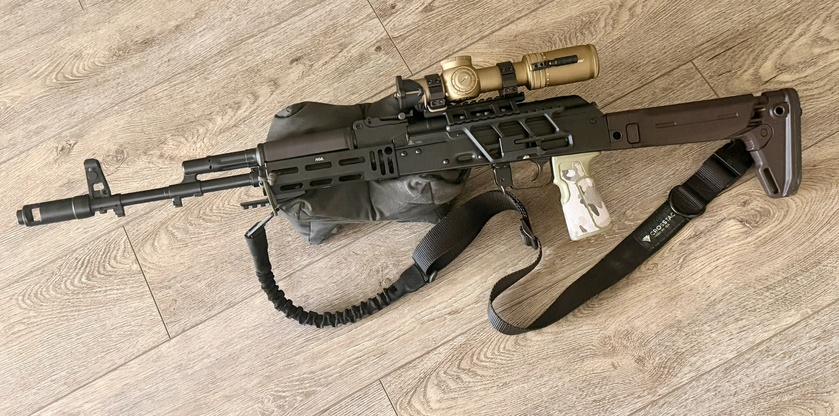
MD25 has been sitting on a 22LR, while the Paralow is on my AK-E in front of a removable 6x Aimpoint magnifier. It is a surprisingly capable combination.

Other holdover equipped red dot sights that benefit from a magnifier have been filtering out bit by bit. Sig's Rome 4T I tested a while back (https://bit.ly/3IKIEAD) was one of them and there are, of course, others.

Aside from the ACSS models, the one I have probably used the most is Shield's SIS, but the specific version I have is no longer made. I am trying to convince them to bring back a version of the SIS that allows for holdover and there is a fair chance of that as electronic supply chain issues resolve themselves.

Interested? Want to learn more about the community?

Learn more first
What else you may like…
Videos
Posts
Articles
Aftermarket ND magazines for Tikka T1x

Tikka T1x is wonderful.
They are stupid accurate right out of the factory for not a lot of money.
The magazine it comes with is adequate, but not ideal.
I tried to get a +5 extension for it, but that disintegrated on the second stage of a rimfire side match we had in Raton.
A gentleman who was shooting right after me with his daughter was running two T1X rifles flawlessly using a metal magazine of some sort.
It turned out there is a Canadian company called ND Supply that makes metal 10rd and 15rd magazines for T1x.
It is not cheap at $70, but I got one and it has been flawless.

https://ndrshootingsupplies.com/15-round-magazine-tikka-t1x-22-lr/

00:05:17
PA PLxC 1.5-12x36 First Look at the scope and the Griffin Mil G2 reticle

Here are some initial thoughts on the scope and the reticle.
Overall, I like what I see.
I am not crazy about some features of the reticle, like the ranging bars and the aiming chevron, but in this implementation, they do not get in the way much.
The chevron is not my preferred aiming point, but in a scope of this size it works fine.
https://alnk.to/cb65zpi

At first blush, there might be a couple of things I'd do differently with this scope, but a lot of that is really just personal preference.

As is, the way this scope is conceptualized, is very true to the MPVO idea.

00:10:19
Armasight Thermal vs Night Vision

During the livestream last week, I promised to upload a side-by-side video of the same basic scene through a day scope with thermal clip-on and through the same day scope with the same camera, but with a night vision clip-on.
The day scope is Element Theos 2-10x42. https://alnk.to/7BimZJf It is set on 2x for the thermal and 2.5x for the NV to match the FOVs of the clip-ons.
Technically, to match the FOV of the Operator https://alnk.to/44ZdnoG I would need ~1.5x magnification of the day optic, but Theos only goes down to 2x. Armasight Operator 640 horizontal FOV is ~12.5 degrees.
For the night vision CO-LR, https://alnk.to/apWuGKV also from Armasight, the FOV is 9 degrees, which is right around 2.5x for most conventional day scopes.
A few things to keep in mind:
1) Both videos were shot with the same rather nice camera, but it does look a little better with a human eye. The way we see is a bit different and we adapt to the image better than any camera.
2) I intentionally set up the ...

00:03:08
On magnification ratio

The subject of magnification ratio (often referred to by the mildly pornographic name "erector ratio" ) comes up relatively frequently on forums these days.
Lately, there is a trend for being very dismissive of riflescopes with high erector ratios. Since this consideration should be more along the lines of guidelines rather than absolutism, I thought I'd offer some thoughts.
Here is what I mean by absolutism, in this case. Rather commonly someone would go on a rant that a particular scope they saw is awful and that is due to it having a very high erector ratio. Most commonly, I see it with LPVOs where someone would be singing praises to a 1-8x24 while crapping all over the 1-10x24. In the same paragraph, they will say that the said 1-10x24 is good up to 8x, but gets dark (or displays some other image artefact) above 8x. If that is true, what is, then, the downside of getting a 1-10x if it gives you everything that a 1-8x offers plus somewhat stunted, but still available higher magnifications?
Or someone ...

Hunting scope video from Area 419

With my cameo. It is a good video despite that.

Shooting off of a tripod

As I was sitting here and scripting out a video on tripod shooting, Phil went ahead and posted this. I can no explain it any better.

post photo preview
Visiting with TacomHQ

This week was my kids' spring break, so we ended up going on a road trip of sorts.  We flew to Houston, rented a car, visited the Space Center, checked out Galveston, then drove up to Dallas.  My dayjob is in Dallas and I need to visit the office occasionally.  Truthfully, I need to visit the office more often than I currently do, but given my family situation that is a little tricky.

My kids are very good travel companions, so we decided to drive back to Albuquerque instead of flying.  The way the timing worked out, we had a day to make a detour and drive up to Arkansas to visit John Baker and his Tacom HQ operation.

I've known John for a few years.  He has visited with me about three years ago to talk about his their reticle idea and a few other things  

I think the reticle idea is sound and we should see a version of it in a scope soon enough.  I'll do a thorough coverage at that point.

This time around, the reticle was not the main reason behind my visit.  John is a creative guy and they do several interesting things there.  Everything they do is clever and outside the box.  For example, to the best of my knowledge, they were the first to come up with different ways to shift the POI for ELR shooting with their TARAC devices.  Alpha and Bravo TARAC devices use prisms to shift the zero of the optic, but a predetermined angle.  I have a flip-up Alpha TARAC set up to help with my subsonic ELR pursuits.  Bravo TARAC attaches the prism to the objective of the riflescope which works beter with large objective designs.  Since Tacom came up with it, the idea has been pirated by a couple of people, most prominently by Nightforce.  Technically, Tacom has a patent on it, but this appears to be a situation where a large company (Nightforce) shamelessly muscled a small company (TacomHQ) out of their IP, knowing fully well that they have more money for lawyers.  To be fair, John does not talk about it too much, so this is just a guess on my part (although I am sure I am going to get a nastygram from Nightforce lawyers for posting this.  They seem to really enjoy pushing small independent guys around).

Charlie Tarac uses a periscope instead of a prism to optically add slope for ELR shooting.  Delta Tarac does mostly the same things except it also offsets the line of sight laterally to avoid the mirage from the barrel.

The new thing with TARAC devices for this year seems to be an adjustable version of the Charlie.  There is a large side wheel that allows you to dial up to 900MOA of extra slope.

The reason I wanted to spend a little time with Tacom was the structured barrel.  I first ran into this concept a few years ago and thought it was an interesting idea.

Initially, my plan was to pick an appropriate action and have John make me a 300NM structured barrel for an ELR bolt action rifle.  I still want a 300NM and I might put one together eventually.  However, I never quite pulled the trigger on that for a few reasons.  One is that I simply have very limited use for such a gun.  I still want one, but I do not have easy access to a place wehre I can really stretch the legs of a caliber with that kind of capability.  The reason I wanted to put one together with a structured barrel is that they are are getting very good lifetime out of these and they are very easy to get to shoot properly.  

They have several version of the structured barrel design, but fundamentally they start with a 1.5" diameter barrel blank and mill out a bunch of material.  The most disinctive features are deep longitudinal cylindrical channels drilled parallel to the bore.  The start at the muzzle and go back toward the chamber.  They do not make it all the way to the chamber.  On the outer surface of the barrel, there are additional featuers designed for eliminating vibrational nodes and increasing surface area for better heat exchange.  There is quite a lot of technical informaiton on their website: https://tacomhq.com/structured-barrels/

Structured barrels look very beefy because they start out from large diameter blanks and they are decidedly not light-weight barrels.  However, by the standards of typical match barrels they are on the lighter side of things because of how much material has been removed.  Given their impressive vibration dampening advantages, a few months ago I shifted gears and started leaning toward putting together a large frame AR around Tacom's structured barrel.

With the precisely calculated mechancial structure, these barrels acomplish two very complicated things simultaneously: they are harmonically dead and they do not get hot.

During my visit, we shot two guns with structured barrels: a 6.5CM AR-10 and a 300NM bolt gun.

We did not do mag dumps or anything that silly.  However, after 10 rounds of rather rapidly fired 6.5CM, the barrel was warm, but not hot.  Temperature distribution was arguably the most remarkable part.  Using an infrared thermometer, it was easy to show that the warmest part of the barrel was around the middle (near the gas block on the semi-auto),  The breech end of the barrel was cooler to the touch and measure at a lower temperature.  Basically, the barrel never got very hot and whatever heat it accumulated was shed very rapidly.

The feel of the recoil impulse is really odd in that it is completely muted and there was no muzzle rise to speal off.  I suspect a part of the was the muzzle brake, but this lack of discernible resonant frequencies made the recoil cycle extremely gentle.  I was shooting an IPSC at 350 yards and the recoil impulse never moved the reticle off the plate.  I fired the last four shots as rapidly as I could pull the trigger.  Everything was on the plate.  The rifle was not light at right around 14lbs with the scope, but I expected a lot more movement out of it even with the muzzlebrake.  Most gas guns have this slight "pitchiness" to them and I saw none of that.

The 300NM boltgun was slightly heavier, but with the much more powerful round the recoil did move the reticle off of the target, but not by much. 

I never lost sight of the target during the reocil impulse and the feel was, again, very muted and controllable.  I am not sure how heavy the boltgun was, but definitely less than 20lbs.  I would guess it was around 17lbs, but I'll check with John.

While both guns were very impressive, the semi-auto shot unlike any other gas gun I have ever pulled the trigger on.  No gas gun ever has a truly free floated barrel, since there is a gas block attached to it.  However, the combination of the structured barrel with a unque way that John has of putting the upper together, is the closest I have seen to date.

He bonds the barrel extension to the upper receiver and then screws a shouldered barrel into that.  The upper receiver is the Aero M5E1 Enhanced since the beefy upper receiver extension helps decouple the handguard from the barrel.  Also, the rather beefy structured barrel needs a large diameter handguard which this is.  The gas block they make is a custom affair that is probably better described as "tunable" rather than adjustable.  It is not designed for making frequent adjustments.  The idea is to tune your gas system for perfromance and reliability, then leave it alone.  I plan to do exactly that.

Since I was heading this way, I brought the necessary pieces with me for John to put together a 6.5CM upper for me.   Originally, I was thinking of doing it in 6XC for local PRS matches, but now that I shot with it, I want to try using it for NRL Hunter as well.  I think I can make weight without too much trouble.  I'll stick with 6.5CM in order to make power factor for Hunter matches.

Saying that I was impressed would be a gross understatement.  The feel of this gun is absolutely unique and it has recoil control behavior of a 25lbs gun in a 14lbs package.  It is quite remarkable.  Now, in the grand scheme of things, with my nearly 300lbs bulk backing up the gun, recoil control is a relatively straightforward affair.  Since my kids were there with me, I had both of them shoot both guns and watched the recoil cycle very carefully.  The guns barely moved even with a much smaller human behind them.

I know it sounds like magic, but it isn't.  I am not a mechanical engineer, but I spent a good amounf of time going over the materials and thinking through what they are doing with these barrels.  The science behind it is pretty solid.  I am not seeing any obvious holes in their foundational reasoning.  The execution is difficult and the barrels are not cheap.  Aside from good ideas, it takes a lot of skill and know-how to make these.  There is a good chance I will make a permanent switch to these barrels on what I consider my "heavy" precision guns while sticking with the Fix as lighter guns they way they were originally intended to be.  When I say heavy, I mean sub-20lbs with everything and light is sub-13lbs with everything (scope, suppressor, bipod).

Before I wrap up, let's get back to the heat management argument for a moment.  The 300NM I shot was significantly accurate and it is at a bit over 2800 rounds.  That sounds outlandish given that is nearly triple of I would expect out of this caliber.  However, if the chamber never gets very hot, it is possible.  I really want to know how long the 6.5CM John is building for me will last.  I have high hopes.


Read full Article
Here is an interesting question I got after the last livestream
I do read all comments

I got an interesting question via Youtube after the last livestream.  Here is it is verbatim:

"Ilya I hope you read the comments. I’ve got an optics question that I can’t seem to find an answer to. 
In reference to competition style scopes. Ones that seem geared towards PRS or other similar styles of shooting. Is there some good reason that the manufacturers constantly put out stuff with a low end mag that is basically unusable? Weight? Clarity? Something else?
I’m thinking of things like the K540i, Vortex 6-36, Tangent, Zco. I’ve never seen anyone shoot these scopes below 10x and most of their reticles are completely unreadable at low magnification. Why not start the low end at something like 10x or 12x and use a similar or lower zoom ratio? A 10-30 seems much more useful in PRS compared to a 5-25 since it’s my understanding that a lower zoom ratio is easier to make."

The biggest reason is simply marketing.  People who actually compete are a relatively small minority.  They do not really need low magnification.  Most people who spend money on scopes are looking at specs and a large magnification ratio is more marketable.  There are of course other practical reasons too.

When you design a riflescope, you are generally trying to hit multiple birds with one stone.

For example, if you want it to appeal to some potential military contracts, you need some sort of a viable low magnification to use with clip-ons.  Many of the clip-ons available to the military work pretty well on higher magnifications, but they generally want to have low pwoer in the 4x to 7x range.

As far as the reticle not being usable on low power, that is a consequence of making reticle very thin for use on high power.  This is also where military applications and civilian competition applications have different needs.  More military oriented reticles tend to be slightly thicker and I often prefer those.  

However, the simple truth is that reticle illumination pretty much solves that problem nicely since most low power use is in low or fading light.

The extended range features of a reticle (christmas tree, etc) seldom come into play in low light, so if the reticle simply has something like an illuminated cross, it works very well.

For what it is worth, even in daylight, I shoot my Tangents below 10x all the time, though not much belwo 10x.  In NRL Hunter matches, for example, since I am pretty new at this and have a hard time finding the plate, I figured out during my very first match that keeping my 7-35x Tangent on 9x, really helps me get behind the rifle quickly and get it stable quickly.  As I got a little better at getting into a proper shooting position efficiently, I bumped it up to about 12x.  When practicing, I routinely keep magnification low when shooting off of props.  When I am not pressed for time and shoot a bit further out, I'll bump up the magnification a little to have a better look at the mirage.  However, I virtually never shoot above 20x unless I am screwing around with some very small targets at close ranges (like the 1/4" hanger on the KYL rack) which is mostly done with rimfires and airguns.

Moving on.... a few years ago when I was chatting with a guy who designs riflescopes for a living, I asked him that the ideal magnification ratio is, where you have a good enough magnification range without any really significant optical compromises.  He said that it is right around 5x, i.e. 5-25x, 7-35x, etc.  When riflescope optical systems are designed, they are not all ground up designs.  For example, you can take a well worked out erector system and use it in a range of scopes.  LPVOs are a little different, but you can use more or less the same erector and eyepiece for several different designs: 2-12x, 3-18x, 4-24x, 5-30x can have very significant part commonality.  Noone is itching to design a standalone 3x erector just for the highest magnification scope because it just adds extra cost and might not offer any advantages beyond potentially slightly lighter scope and somewhat easier assembly/alignment.  

The idea of a competition dedicated high power riflescope that is 10-30x or something along those lines comes up every few years as does the concept of a dedicated 14x fully optimized for matches.  Every time, it fails the basic test of economics: how much will it cost to develop vs how many you might sell.

Read full Article
post photo preview
Zenith Rifle by Alpine Riflecraft
First Look at The Ultimate Mountain Rifle

As many of you are likely aware, I am heading out to Montana for a mule deer hunt in a few days.  I will also have an additional cow elk tag, since I did not draw anythign in New Mexico.

My original plan was to borrow one of the MegaFix prototypes from Q.  However, all three properly fucntioning prototypes of the MEgaFix they have are in Africa taking down a broad range of animals.  The way I go hunting usually involves two rifles.  One primary, which is typcially something I am doing an article on and one backup which is something I know works in case I need it in a pinch.

My backup rifle is the OG Fix chambered for 308Win.  You have seen this gun many times over the years.  It was the subject of a dedicated video.  

I hunt with it and occasionally shoot NRL Hunter matches with it (shot two this year).  

As configured, it clocks in at a bit under 11lbs with the scope, https://alnk.to/af179CG, bipod, full length Arca rail from Sawtooth and LSP vertical grip.  I could make it a little lighter, but after some consideration, I decided to keep it in this configuration.  Eventually, I will upgrade it to Area 419 rings (I have been slowly switching to them almost across the board), but beyond that I plan to do absolutely nothing with it until I finally shoot the barrel out.  Ammo is a different ballgame and I am about to embark on an experiment with NAS3 cases, but that's a story for another day.

I still wanted somethign new to test, so I reched out to my Guns & Ammo editor to see if he has any ideas.  He usually does and this case was not the exception.  He connected me with a gentleman who owns a Canadian company called Alpine Riflecraft.  They are on a mission to make the world's best mountain hunting rifle and the Zenith is the product of their efforts.

I have now spent a couple of days at the range with it and have some early impressions to share.

Only for Supporters
To read the rest of this article and access other paid content, you must be a supporter
Read full Article
Available on mobile and TV devices
google store google store app store app store
google store google store app tv store app tv store amazon store amazon store roku store roku store
Powered by Locals