

DarkLordOfOptics
Politics • Science & Tech • Sports
Guns, Optics, 2nd Amendment and resisting the Left in everything they touch.
Interested? Want to learn more about the community?

Learn more first
Livestream tonight

I am going to go Live on Yutube, Facebook and Odyssee later today at 7PM MDT.

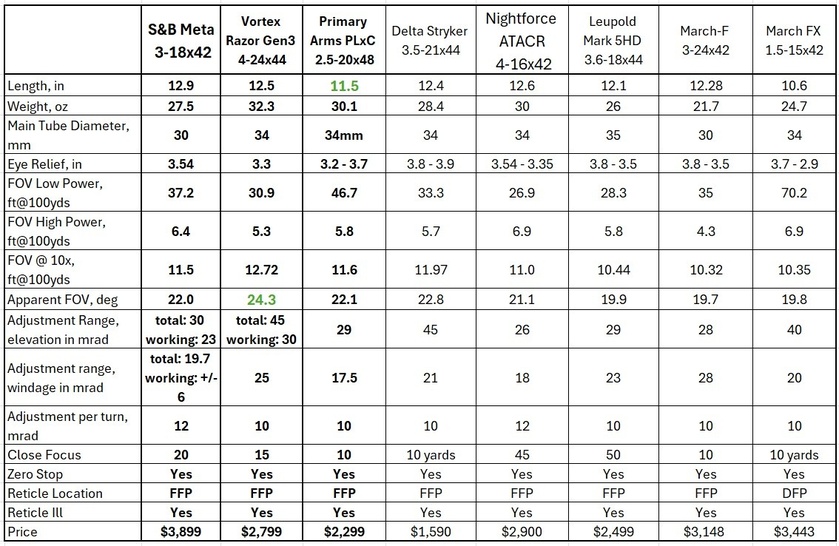
The discussion topic is on how manufacturers optimize (or should optimize) riflescope designs. This will be a very top level discussion followed by the customary Q&A.

Interested? Want to learn more about the community?

Learn more first
What else you may like…
Videos
Posts
Articles
Nuclear Bright FFP LPVOs

This is a re-upload, so if you receive two notifications, my apologies.
The original upload got stuck on processing the video.

This originally started as a review of the Vortex AMG 1-10x24, but ended up being more of a direct comparison of what you get with these three modern LPVOs that have nuclear bright reticle illumination:

Vortex AMG 1-10x24 https://eurooptic.sjv.io/rEQm1y
Primary Arms PLxC 1-8x24 https://alnk.to/9xnqt1y
Vortex Razor Gen3 1-10x24 https://eurooptic.sjv.io/rEQm1y black anodize or https://alnk.to/4XzIXQ9 for bronze anodize

The first question will always be why I selected these specific three scopes. The obvious answer is simply because I had them. I was really hoping to get the new SAI10 here since it goes head to head against these group, but that was delayed. I will do an update when it gets here.

Why did I not include the two Nightforce options: NX8 and ATACR? Several reasons. Mostly because they have been around for a while and are a known quantity. I have looked at both...

00:28:27
Flashlights: Olight Odin Mini and PL X

Late last year Olight reached out to me and asked me if I want to review a couple of flashlights. I had never spent any time with any Olight products, so I took a quick look at the available specs and decided to give it a shot.
I suspect that Olight is quite irritated with me since, apparently, the stipulate a specific timeline to reviewers when they send them products. I was blissfully unaware of that (maybe I should have read the fine print) and did my usual thing where I spend an ungodly amount of time with whatever I happened to be reviewing before I run my mouth.

This video is long. I have hundred of rifle rounds and well over a thousand of handgun rounds behind each light. They shook a little loose, but not too much.

Beam evaluation you see in this video was done after lots of shooting.

Beam quality is quite good, but these are relatively budget lights, so I was pleasantly surprised. Build quality is also quite respectable

https://amzn.to/4x7Wpnt
https://amzn.to/3REL51O...

00:53:50
Long overdue: Element Theos 2-10x42

The amount of time I spent on this scope trying to find something really significant to nitpick on is borderline embarrassing. Yet, other than the original observations on it being a little heavy and that the reticle could have benefited from a couple more numbers, I really did not come up with much of anything.

It is decidedly a precision-oriented MPVO, yet it does everything well. In terms of pure optimization and understanding the real purpose of what these scopes are used for, the baby Theos is just superb.

While the current iteration of the excellent Primary Arms 1.5-12x36 PLxC is aimed at AR guys stepping up, the Theos is set up just right for precision guys trying to equip their accurate semi-auto with something a little smaller and lower magnification.

It is an absolutely exemplary design for stretching the range of an accurate DMR.

At the time when this is written EO has one for $2049, https://eurooptic.sjv.io/enEP06 which is an exceptional price for this scope. I thought it was...

00:22:35
Looking at red dot sights a little bit.

Red dot sights, for me, are kind of a love/hate thing.
Modern red dot sights are awesome. However as I get older I need them more yet I can use them for less.
As your eyes change, you often end up developing mild astigmatism and age related presbyopia.
Astigmatism is basically a condition where saggital and tangential rays do not focus on the same spot. When you look at a red dot and the aiming point is not round, astigmatism is what's causing it.
Presbyopia is the gradually worsening inability to focus on anything close to you. That's why I now have to wear contacts (I have been near sighted most of my life) to see far and then reading glasses to work on the computer and read.
Astigmatism limits how far I can shoot with a red dot, but even with a misshapen aiming point, hitting a human torso size targets out to 75 yards or so is not an issue.
Presbyopia makes it increasingly harder to use iron sights. That's one of the reasons I use red dot sights on most of my handguns. Where I do use iron sights, I have developed a strong preference to ...

Aeroprecision Bankruptcy

It looks like Aero finally announced that they are going through a bankruptsy. That explains why they are bombarding me with emails that everything is half off.
I suppose that a combination of a down market and being located in very gun unfriendly Washington state was not good for Aero and their portfolio companies: Ballistic Advantage and Stag Arms.
The claim is that the companies are operating through this transition, but it has not been announced whether someone is going to buy up the assets and keep them running.

post photo preview
Another heads up: PA HTX-1 red dot sight is in stock briefly.

Primary Arms released another batch of their US made red dot sights onto the website: https://alnk.to/eDVnzqG

I have been running one for some time and, aside from being US made, it is very well engineered.

Spartan's CP Brace: Initial Impressions
In pursuit of stability

It has been a little time since I talked about Spartan Precision bipods and tripods.  That is largely due to my preoccupation with precision shooting during the last year and a half or so. 

I have two pieces of gear from Spartan: Ascent tripod https://alnk.to/28VEg3S and Javelin bipod https://alnk.to/gVPiEBd.  Both are very well made and rather quick to deploy, but they are not quite stable enough for the competition oriented endeavors I have been focusing on.  

For competition, it has been predominantly large diameter inverted leg tripods, like Zeiss' Max Duty kit and Triple Pull Ckyepod.  Inverted leg tripods are measurably faster to deploy and adjust when on the clock.  Triple Pull Ckyepod gives me the flexibility to shoot prone, sitting or kneeling in a pinch.

For hunting, however, I have been using the Spartan gear I listed above because it is light, easy to pack, fast to deploy and exceedingly well made.  It also really helps that the legs of the Ascent tripod come off for easier packing and for use as hiking sticks (that is highly useful when packing meat out and I like the idea of not needing to carry around separate walking sticks.

Most of my hunting rifles that I am not willing to attach a bipod to on a mostly permanent basis are set up for Spartan's Magnaswitch adapter.   It is slick, unobtrusive and can be used to snap either a bipod or tripod in.  It is not quite as stable at distance as a proper large diameter match tripod, but it is very fast to deploy and stable enough for my hunting purposes.

In the last few years, tripods have become an indespensible tool precision shooting when terrain is not conducive to shooting prone.  We use tripods for observation and target ID with binoculars and then immediately switch to using them for shooting support.  That is where things start to diverge a bit.

Some people clip the rifle into the Arca head of the tripod (that's what I have been doing lately).

Some keep a tripod table clipped in and do both glassing and shooting off of a bag sitting on top of the tripod table (that's what I started out with originally, but managing extra gear took too long.  I am more efficient now, so it might be time to re-visit this).

Some of the top competitors use two tripods for front and rear support (that's more gear manipulation than I am comfortable with).

When there is a front support, whether a tall bipod or a prop of some sort or just a convenient terrain feature, tripods are routinely used as a rear support to stabilize the butstock of the rifle.  That is what's commonly referred to as "tripod rear".

I have been trying to keep things simple and mostly just shot with the rifle clipped into the tripod.  I got quite competent at it when shooting at the range, but it has been a bit of a struggle in the last two matches (I also had some health issue in parallel, but I suspect that it had more to do with me screwing things up under time pressure than health concerns).

Still, while I continue to practice shooting with the rifle clipped into the tripod, both standing and kneeling, it was time to expand my horizons and try to master various variants of "tripod rear" support.

That is when I stumbled onto Spartan's CP Brace that offers a completely different approach to using a tripod for two point rifle support.

 It is a very clever idea.  They are, essentially, creating a bridge betweeh two legs of the tripod that has a compact tripod head attached to it.  That is the front support.  The rear support is the tripod's third leg where, similarly to the conventional "tripod rear" setup, you use your support hand to anchor the buttstock of the rifle to the leg of the tripod.

Like everythign Spartan makes, CP Brace is not cheap, so I figured I should take one for the team, do some experimentation and let you know what I find.

Only for Supporters
To read the rest of this article and access other paid content, you must be a supporter
Read full Article
Will HICAR and 6.5CM+Peak kill the M7 and 6.8x51?
One part of my hopes that it will. On the other hand, I hope that it will not.


Either way, it is going to continue to be a mess.

Last month, powers that be issued a solicitation for the HICAR program:
https://sam.gov/workspace/contract/opp/b1a57529aa574e8ba220e0311434733e/view

HICAR stands for "Hypervelocity Improved Capability Assault Rifle"

The solicitation is specific to SOCOM, rather than the larger branches of the military.  However, I strongly suspect that it is a harbinger of smarter things to come than the general issue of anything chambered for the 6.8x51 (aka as 277 Fury in the civilian world).

Only for Supporters
To read the rest of this article and access other paid content, you must be a supporter
Read full Article
post photo preview
Visiting with TacomHQ

This week was my kids' spring break, so we ended up going on a road trip of sorts.  We flew to Houston, rented a car, visited the Space Center, checked out Galveston, then drove up to Dallas.  My dayjob is in Dallas and I need to visit the office occasionally.  Truthfully, I need to visit the office more often than I currently do, but given my family situation that is a little tricky.

My kids are very good travel companions, so we decided to drive back to Albuquerque instead of flying.  The way the timing worked out, we had a day to make a detour and drive up to Arkansas to visit John Baker and his Tacom HQ operation.

I've known John for a few years.  He has visited with me about three years ago to talk about his their reticle idea and a few other things  

I think the reticle idea is sound and we should see a version of it in a scope soon enough.  I'll do a thorough coverage at that point.

This time around, the reticle was not the main reason behind my visit.  John is a creative guy and they do several interesting things there.  Everything they do is clever and outside the box.  For example, to the best of my knowledge, they were the first to come up with different ways to shift the POI for ELR shooting with their TARAC devices.  Alpha and Bravo TARAC devices use prisms to shift the zero of the optic, but a predetermined angle.  I have a flip-up Alpha TARAC set up to help with my subsonic ELR pursuits.  Bravo TARAC attaches the prism to the objective of the riflescope which works beter with large objective designs.  Since Tacom came up with it, the idea has been pirated by a couple of people, most prominently by Nightforce.  Technically, Tacom has a patent on it, but this appears to be a situation where a large company (Nightforce) shamelessly muscled a small company (TacomHQ) out of their IP, knowing fully well that they have more money for lawyers.  To be fair, John does not talk about it too much, so this is just a guess on my part (although I am sure I am going to get a nastygram from Nightforce lawyers for posting this.  They seem to really enjoy pushing small independent guys around).

Charlie Tarac uses a periscope instead of a prism to optically add slope for ELR shooting.  Delta Tarac does mostly the same things except it also offsets the line of sight laterally to avoid the mirage from the barrel.

The new thing with TARAC devices for this year seems to be an adjustable version of the Charlie.  There is a large side wheel that allows you to dial up to 900MOA of extra slope.

The reason I wanted to spend a little time with Tacom was the structured barrel.  I first ran into this concept a few years ago and thought it was an interesting idea.

Initially, my plan was to pick an appropriate action and have John make me a 300NM structured barrel for an ELR bolt action rifle.  I still want a 300NM and I might put one together eventually.  However, I never quite pulled the trigger on that for a few reasons.  One is that I simply have very limited use for such a gun.  I still want one, but I do not have easy access to a place wehre I can really stretch the legs of a caliber with that kind of capability.  The reason I wanted to put one together with a structured barrel is that they are are getting very good lifetime out of these and they are very easy to get to shoot properly.  

They have several version of the structured barrel design, but fundamentally they start with a 1.5" diameter barrel blank and mill out a bunch of material.  The most disinctive features are deep longitudinal cylindrical channels drilled parallel to the bore.  The start at the muzzle and go back toward the chamber.  They do not make it all the way to the chamber.  On the outer surface of the barrel, there are additional featuers designed for eliminating vibrational nodes and increasing surface area for better heat exchange.  There is quite a lot of technical informaiton on their website: https://tacomhq.com/structured-barrels/

Structured barrels look very beefy because they start out from large diameter blanks and they are decidedly not light-weight barrels.  However, by the standards of typical match barrels they are on the lighter side of things because of how much material has been removed.  Given their impressive vibration dampening advantages, a few months ago I shifted gears and started leaning toward putting together a large frame AR around Tacom's structured barrel.

With the precisely calculated mechancial structure, these barrels acomplish two very complicated things simultaneously: they are harmonically dead and they do not get hot.

During my visit, we shot two guns with structured barrels: a 6.5CM AR-10 and a 300NM bolt gun.

We did not do mag dumps or anything that silly.  However, after 10 rounds of rather rapidly fired 6.5CM, the barrel was warm, but not hot.  Temperature distribution was arguably the most remarkable part.  Using an infrared thermometer, it was easy to show that the warmest part of the barrel was around the middle (near the gas block on the semi-auto),  The breech end of the barrel was cooler to the touch and measure at a lower temperature.  Basically, the barrel never got very hot and whatever heat it accumulated was shed very rapidly.

The feel of the recoil impulse is really odd in that it is completely muted and there was no muzzle rise to speal off.  I suspect a part of the was the muzzle brake, but this lack of discernible resonant frequencies made the recoil cycle extremely gentle.  I was shooting an IPSC at 350 yards and the recoil impulse never moved the reticle off the plate.  I fired the last four shots as rapidly as I could pull the trigger.  Everything was on the plate.  The rifle was not light at right around 14lbs with the scope, but I expected a lot more movement out of it even with the muzzlebrake.  Most gas guns have this slight "pitchiness" to them and I saw none of that.

The 300NM boltgun was slightly heavier, but with the much more powerful round the recoil did move the reticle off of the target, but not by much. 

I never lost sight of the target during the reocil impulse and the feel was, again, very muted and controllable.  I am not sure how heavy the boltgun was, but definitely less than 20lbs.  I would guess it was around 17lbs, but I'll check with John.

While both guns were very impressive, the semi-auto shot unlike any other gas gun I have ever pulled the trigger on.  No gas gun ever has a truly free floated barrel, since there is a gas block attached to it.  However, the combination of the structured barrel with a unque way that John has of putting the upper together, is the closest I have seen to date.

He bonds the barrel extension to the upper receiver and then screws a shouldered barrel into that.  The upper receiver is the Aero M5E1 Enhanced since the beefy upper receiver extension helps decouple the handguard from the barrel.  Also, the rather beefy structured barrel needs a large diameter handguard which this is.  The gas block they make is a custom affair that is probably better described as "tunable" rather than adjustable.  It is not designed for making frequent adjustments.  The idea is to tune your gas system for perfromance and reliability, then leave it alone.  I plan to do exactly that.

Since I was heading this way, I brought the necessary pieces with me for John to put together a 6.5CM upper for me.   Originally, I was thinking of doing it in 6XC for local PRS matches, but now that I shot with it, I want to try using it for NRL Hunter as well.  I think I can make weight without too much trouble.  I'll stick with 6.5CM in order to make power factor for Hunter matches.

Saying that I was impressed would be a gross understatement.  The feel of this gun is absolutely unique and it has recoil control behavior of a 25lbs gun in a 14lbs package.  It is quite remarkable.  Now, in the grand scheme of things, with my nearly 300lbs bulk backing up the gun, recoil control is a relatively straightforward affair.  Since my kids were there with me, I had both of them shoot both guns and watched the recoil cycle very carefully.  The guns barely moved even with a much smaller human behind them.

I know it sounds like magic, but it isn't.  I am not a mechanical engineer, but I spent a good amounf of time going over the materials and thinking through what they are doing with these barrels.  The science behind it is pretty solid.  I am not seeing any obvious holes in their foundational reasoning.  The execution is difficult and the barrels are not cheap.  Aside from good ideas, it takes a lot of skill and know-how to make these.  There is a good chance I will make a permanent switch to these barrels on what I consider my "heavy" precision guns while sticking with the Fix as lighter guns they way they were originally intended to be.  When I say heavy, I mean sub-20lbs with everything and light is sub-13lbs with everything (scope, suppressor, bipod).

Before I wrap up, let's get back to the heat management argument for a moment.  The 300NM I shot was significantly accurate and it is at a bit over 2800 rounds.  That sounds outlandish given that is nearly triple of I would expect out of this caliber.  However, if the chamber never gets very hot, it is possible.  I really want to know how long the 6.5CM John is building for me will last.  I have high hopes.


Read full Article
Available on mobile and TV devices
google store google store app store app store
google store google store app tv store app tv store amazon store amazon store roku store roku store
Powered by Locals